
-
01/22/2026
- 0 Комментарий
Линейные направляющие против линейных валов
As a Senior Engineering Director with over 15 years of experience in industrial equipment design, production, and optimization, I have overseen countless projects where the choice between linear rails and linear rods directly impacted equipment performance, reliability, and total cost of ownership (TCO). Linear rails (also called linear motion rails, linear guide rails, or linear slide guide rails) and linear rods (also known as linear shafts, linear guide shafts, or linear slide shafts) are both core components for linear motion systems, but they are not interchangeable—each excels in specific scenarios, and misselection can lead to costly rework, premature failure, or underperformance. This is especially critical when evaluating linear rails and bearings, linear rods and bearings, or linear bearing rail systems, as these component pairings define motion system capability. In this article, I will break down the fundamental differences between linear rails and linear rods, explore what is a linear guide and what is a linear bearing, and detail performance trade-offs, application boundaries, and key selection principles from an engineering leadership perspective—helping teams make strategic, data-driven decisions that align with project goals, whether selecting linear rails for CNC, heavy duty linear guide rails, or affordable cheap linear guide options.
The Core Difference
What is Linear Rails (Linear Guides)?
what is Linear Rods (Linear Shafts)?
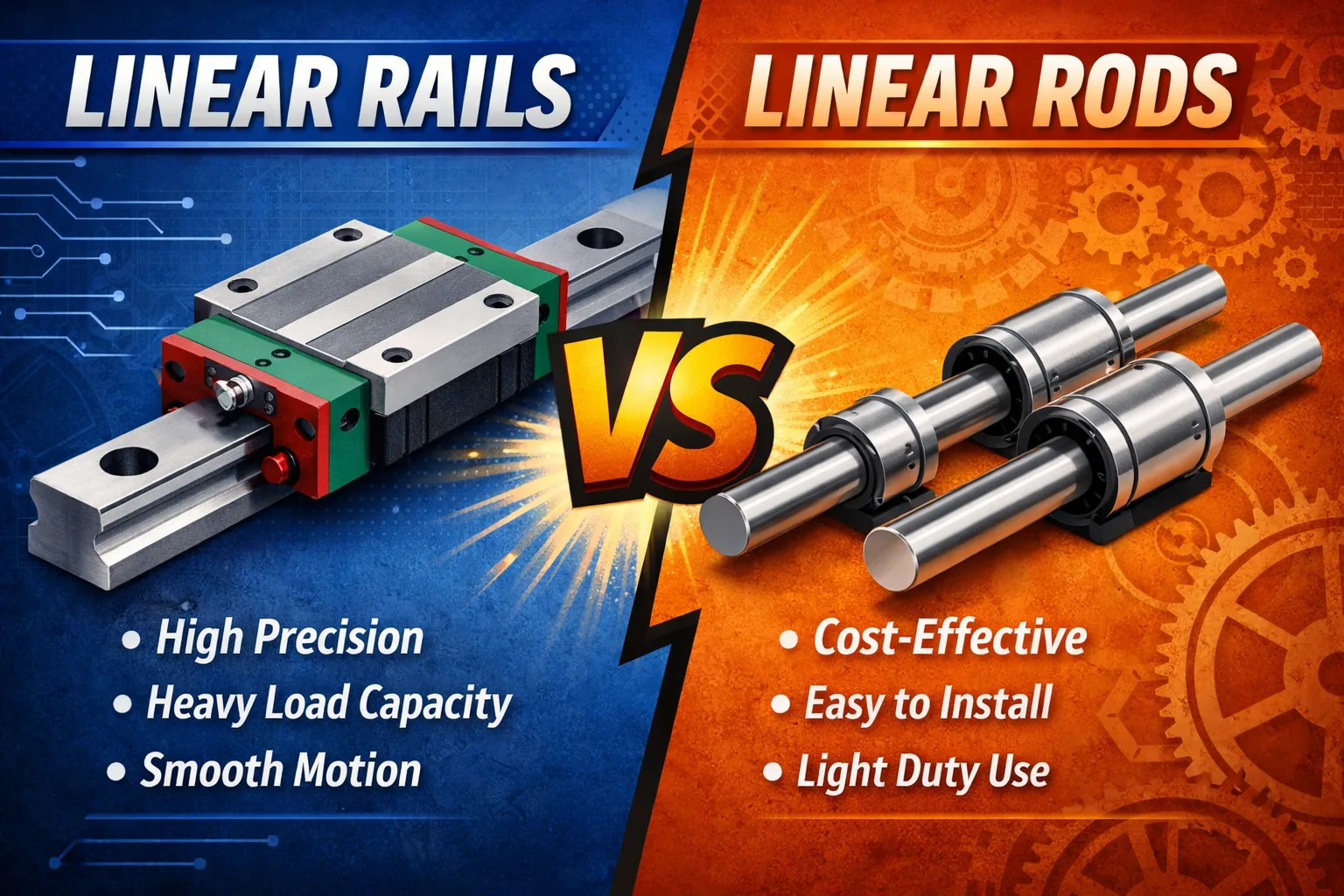
Linear rods (also called linear guide shafts, linear slide shafts, or simply linear rod) are simple, cylindrical shafts (precision-ground or polished) paired with linear rod bearing components—most commonly linear bearings and rods, rail linear bearing setups, or bearing guide rails that act as supports. Unlike linear rails, linear rods are a “component-level” solution—they require external supports (e.g., end blocks, brackets) to maintain alignment, and their performance depends heavily on the precision of the supporting structure and the quality of the linear rod bearing pairing. This design prioritizes simplicity, cost-effectiveness, and compactness, making linear rods and bearings a popular choice for small, space-constrained applications.
Linear rods operate on a single-axis, point-contact principle (between the linear rod bearing and the rod’s surface). While a high-quality linear rod paired with a precision linear bearing can achieve moderate precision (±0.01mm repeatability), their rigidity and load-bearing capacity are limited by the linear rod’s diameter and the linear rod bearing type. Plain linear rod bearing options are cost-effective but prone to wear in high-speed applications, while ball-based linear bearing rail systems offer lower friction but require more frequent lubrication and protection from contaminants. Linear rods and bearings are often used in simple linear motion systems, such as manual assembly stations or low-speed conveyors, where precision and load capacity requirements are moderate. Linear tracks for linear rods are typically simpler than those for linear rails, focusing on stable support rather than integrated motion control.
What Matters for Engineering Leaders?
Performance Metric | Linear Rails (e.g., CNC linear guide rails, precision linear guide) | Linear Rods (with linear rod bearing, linear bearings and rods) |
Precision (Repeatability/Accuracy) | High (±0.001–±0.01mm); consistent across travel (ideal for precision linear guide, CNC linear slide applications) | Moderate (±0.01–±0.1mm); dependent on support alignment and linear rod bearing quality |
Rigidity & Load Capacity | High; multi-contact design handles radial/axial loads and torque (excellent for heavy duty linear guide rails, supported linear rail) | Low to Moderate; limited by linear rod diameter and linear rod bearing type |
Friction & Speed | Low friction; suitable for high-speed, continuous motion (e.g., linear ball guide, CNC linear slide) | Higher friction (plain linear rod bearing); ball-based linear bearing rail offers low friction but lower durability |
Upfront Cost | Higher (2–5x more than linear rods of similar size); varies by linear rail types, materials (stainless steel linear guide rails cost more than standard), and linear rail sizes | Lower; simple design and fewer components (linear rods and bearings are more affordable than linear rail systems) |
Maintenance & TCO | Low maintenance; built-in protection reduces wear; longer lifespan (5–10 years) (applies to most linear rail systems, including stainless steel linear guide rails) | Higher maintenance; linear rod bearing wears faster; support alignment may require rework; shorter lifespan (2–5 years) (common for linear rods and bearings setups) |
Installation & Integration | Simpler; modular design requires minimal alignment (ideal for CNC linear guide rails, linear rail slides) | More complex; requires precision alignment of supports and linear rod bearing components |
Precision and Rigidity: Non-Negotiable for High-Performance Systems
Cost vs. TCO: The Engineering Director’s Priority
Installation and Scalability: Efficiency for Engineering Teams
When to Choose Linear Rails vs. Linear Rods
Choose Linear Rails If
- Your application requires high precision (repeatability ≤ ±0.01mm) or consistent positioning across long travel lengths (≥1m)—ideal for precision linear guide, linear ball guide, or CNC linear guide rails applications.
- The system operates under dynamic loads (e.g., high-speed acceleration, cutting forces, torque) or heavy loads (≥50kg per axis)—suited for heavy duty linear guide rails, supported linear rail, or robust linear rail systems.
- You need low maintenance and long lifespan (≥5 years) for 24/7 or high-duty-cycle operations (applies to most linear rail types, including stainless steel linear guide rails and linear rail slides).
- Scalability is a priority (e.g., future upgrades to dual-rail configurations, additional linear rail bearings, or switching to larger linear rail sizes).
- Examples: CNC machining centers (with CNC linear guide rails, linear rails for CNC, or CNC linear slide components), robotic arms, semiconductor wafer handlers, metrology equipment, high-speed packaging lines, corrosive-environment applications (using stainless steel linear guide rails), and heavy-duty material handling systems (using heavy duty linear guide rails).
Choose Linear Rods If
- Your application has low precision requirements (repeatability ≥ ±0.01mm) and operates at low speeds or low duty cycles—suitable for linear rods and bearings or basic linear bearing track setups.
- Space is at a premium (e.g., compact equipment, small-diameter linear slide shafts ≤10mm) where linear rail sizes are too large.
- Upfront cost is the primary constraint, and maintenance frequency is manageable (e.g., quarterly linear rod bearing checks or replacements)—linear rods and bearings are more affordable than linear rail systems.
- The system handles light loads (≤50kg per axis) and no significant torque or dynamic forces—basic linear rod bearing pairings are sufficient.
- Examples: Material handling carts (using linear rods and bearings), manual assembly stations, low-speed conveyor guides (with linear bearing track components), prototype machines (using simple linear rod setups), simple linear actuators (with linear slide shafts), and compact devices where linear rail sizes are impractical.
Selection Best Practices
- Start with System Requirements, Not Component Costs: Сначала определите требования к точности, нагрузке, скорости и сроку службы — это критически важно для выбора между типами линейных направляющих (например, прецизионные линейные направляющие vs. дешевые линейные направляющие) или валами и подшипниками. Только после прояснения этих параметров следует оценивать стоимость. Наиболее частая ошибка, которую я наблюдаю, — неправильный выбор из-за ориентации на первоначальную стоимость (например, выбор валов и подшипников вместо ЧПУ-линейных направляющих для прецизионного ЧПУ-применения).
- Тестируйте в реальных условиях: Для критически важных применений (например, ЧПУ-линейные направляющие, тяжелонагруженные линейные направляющие) тестируйте как системы линейных направляющих, так и валы с подшипниками в вашей реальной рабочей среде (например, при наличии пыли, вибрации или перепадов температур). Лабораторные испытания не всегда отражают реальную производительность, особенно в отношении износа подшипников скольжения на валах или коррозионной стойкости линейных направляющих из нержавеющей стали.
Сотрудничайте с проверенными поставщиками: Высококачественные линейные направляющие от известных брендов, таких как THK, HIWIN и SKF, а также валы и подшипники от Bosch Rexroth и Misumi, хорошо известны стабильным качеством и длительным сроком службы.
В то же время инженерным командам не следует упускать из виду новых производителей линейных направляющих с многолетним опытом производства, таких как DTX-LG. Эти бренды нового поколения часто предлагают взаимозаменяемые конструкции, стабильный контроль качества и более конкурентоспособное соотношение цены и производительности, что делает их практичной альтернативой для ЧПУ-линейных направляющих и других применений с высоким рабочим циклом.
Независимо от зрелости бренда, избегайте использования недорогих, небрендовых подшипников для линейных направляющих или компонентов валов и подшипников в требовательных средах, поскольку нестабильные допуски и качество материалов могут значительно сократить срок службы и увеличить совокупную стоимость владения.
- Учитывайте интеграцию с другими компонентами: Убедитесь, что выбранный компонент бесшовно интегрируется с вашим двигателем, приводом и системой управления. Системы линейных направляющих (включая каретки линейных направляющих, модели линейных шариковых направляющих) часто лучше сочетаются с прецизионными серводвигателями для применений с ЧПУ-линейными каретками, в то время как валы и подшипники совместимы с более простыми шаговыми двигателями. Также учитывайте размеры линейных направляющих и диаметры валов, чтобы обеспечить совместимость с существующими креплениями.
- Планируйте техническое обслуживание: Учитывайте техническое обслуживание при расчете совокупной стоимости владения (TCO). Системы линейных направляющих (даже недорогие варианты) снижают трудозатраты на обслуживание, устраняя необходимость частой замены подшипников скольжения на валах, что часто упускается из виду при сравнении первоначальных затрат. Для коррозионных сред линейные направляющие из нержавеющей стали снижают затраты на обслуживание благодаря устойчивости к ржавчине и износу.
Линейные направляющие и валы являются важнейшими решениями в системах линейного перемещения, но их применимость зависит от требований применения и долгосрочных целей проекта. Независимо от того, является ли приоритетом высокая точность, экономическая эффективность или способность выдерживать большие нагрузки, инженерные команды должны оценивать не только первоначальную стоимость, а вместо этого сосредоточиться на совокупной стоимости владения (TCO), надежности и масштабируемости в течение всего жизненного цикла системы.
Линейные направляющие — включая ЧПУ-линейные направляющие, тяжелонагруженные линейные направляющие и линейные направляющие из нержавеющей стали — являются предпочтительным выбором для прецизионных, высоконагруженных применений и применений с высоким рабочим циклом, где точность, долговечность и низкие затраты на обслуживание являются обязательными требованиями. В то же время, валы и подшипники хорошо подходят для компактных, малонагруженных и чувствительных к стоимости применений, где допустима умеренная точность.
Четко понимая функциональные различия между линейными направляющими и подшипниками скольжения, оценивая размеры направляющих и диаметры валов, а также применяя структурированные лучшие практики выбора, инженерные команды могут избежать дорогостоящих компромиссов в конструкции и создавать системы, которые надежно, эффективно и экономично работают в течение многих лет.