
-
01/21/2026
- 0 Commento
Errori di Installazione: La Minaccia Nascosta alla Durata di Servizio delle Guide Lineari
Indice dei contenuti
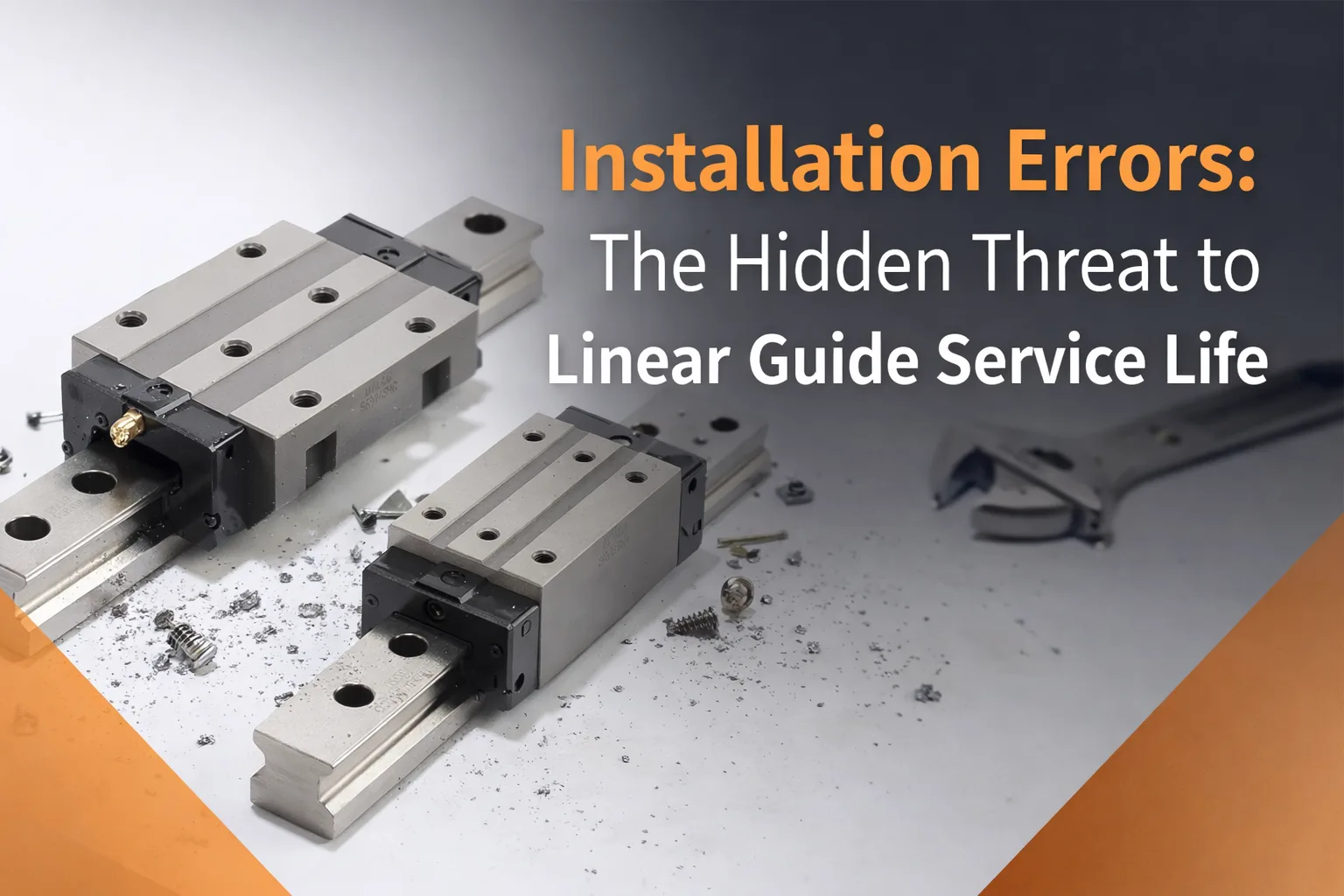
As a professional mechanical assembly engineer, I have witnessed countless cases where linear guides—critical components ensuring precision motion in industrial equipment—fail prematurely not due to poor product quality, but improper installation. Linear guides and bearings rely on ultra-precise contact between rolling elements (balls or rollers) and raceways to deliver low friction, high rigidity, and long service life. Even micron-level installation errors can disrupt this balance, triggering a chain reaction of mechanical stress, wear, and ultimately, catastrophic failure. Below, I will break down how common installation errors degrade guide life, supported by engineering principles and on-site experience.
Installation Error Type | Key Impacts on Linear Guide Life | Mitigation Methods |
|---|---|---|
Base Surface Flatness Error | Local overloading, contact fatigue cracks, increased sliding friction, adhesive wear | Check flatness with straightedge/feeler gauge; grind/mill base to correct errors if needed |
Parallelism Error (Dual-Rail) | Carriage skewing, edge loading, scuffing, cage damage, inconsistent motion accuracy | Use laser interferometer for measurement; adjust with shims (0.005-0.05mm) to correct |
Improper Bolt Tightening | Over-tightening: rail deformation, accelerated fatigue; Under-tightening: micro-movement, impact loads, cage breakage | Use calibrated torque wrench; follow manufacturer’s specs and cross-tightening sequence |
Contamination During Installation | Abrasive wear, raceway scratches, lubricant degradation | Clean surfaces with industrial alcohol; use lint-free cloths; avoid bare hand contact with raceway |
The Core Principle: Why Installation Precision Determines Guide Life
Linear guide manufacturers design their products based on the “ideal contact condition”: the raceway surface maintains uniform load distribution, and rolling elements move without sliding or skewing. Under this condition, the guide operates within its rated dynamic load (C) and static load (C₀), achieving the projected service life (L₁₀ = (C/P)³ × 10⁶ revolutions, per ISO standards).
Installation errors this ideal state by introducing uneven stress, abnormal friction, and micro-impacts. These issues do not manifest immediately; instead, they accumulate over cycles, accelerating material fatigue and wear. For example, a 0.1mm parallelism error can increase local contact stress by 30%—cutting the guide’s service life by half or more, according to our team’s field test data.
Common Installation Errors and Their Impact on Guide Life
Base Surface Flatness Error
- Local Overloading: When tightening the guide’s mounting bolts, the uneven base forces the guide’s rail to deform. This creates “high-stress points” where the rolling elements bear excessive load—far beyond the design limit. Over time, these points develop contact fatigue cracks (visible as small pits on the raceway), which spread and cause the guide to seize.
- Increased Friction: Deformed rails force rolling elements to slide (rather than roll) against the raceway, generating sliding friction (up to 10x higher than rolling friction). This not only raises operating temperature (accelerating lubricant degradation) but also causes adhesive wear (metal transfer between rolling elements and raceways), a leading cause of premature guide failure.
Parallelism Error Between Two Rails (Dual-Rail Systems)
- Skewing of the Carriage: The carriage (which connects the two rails) is forced to tilt, making the rolling elements contact the raceway edges instead of the center. This edge loading concentrates stress on the rail’s shoulders, leading to rapid wear and even chipping of the raceway.
- Torque on Rolling Elements: Skewing introduces a rotational torque on the carriage, causing rolling elements to spin at an angle. This creates scuffing (long, shallow scratches on the raceway) and increases the risk of cage damage (the component that separates rolling elements). Once the cage breaks, rolling elements collide with each other, destroying the guide in hours.
- Inconsistent Motion Accuracy: Even if the guide does not fail immediately, parallelism errors lead to “stick-slip” motion, which damages the workpiece (e.g., uneven cutting in machining) and puts additional stress on the guide over time.
Improper Bolt Tightening (Over-Tightening or Under-Tightening)
- Over-Tightening: Excessive torque (beyond the manufacturer’s specification, e.g., 12 N·m for M6 bolts) causes the rail to compress and deform along the bolt axis. This creates a “wave-like” distortion in the raceway, where rolling elements encounter periodic high-stress zones. Our tests show that over-tightening by 20% reduces guide life by 40% due to accelerated fatigue.
- Under-Tightening: Loose bolts allow the rail to shift slightly during operation. This micro-movement between the rail and base generates impact loads (especially during rapid acceleration/deceleration), which crack the raceway and loosen the rolling element cages. In one case, a conveyor system’s guide failed after 3 months because bolts were tightened to only 50% of the recommended torque—resulting in rail displacement and cage breakage.
Contamination During Installation
- Usura Abrasiva: Le particelle di polvere o i trucioli metallici intrappolati tra gli elementi volventi e la pista di scorrimento agiscono come abrasivi, graffiando la superficie della pista. Questi graffi si approfondiscono ad ogni ciclo, riducendo la capacità di carico della guida e creando concentrazioni di sollecitazione che portano a crepe.
- Degradazione del Lubrificante: I contaminanti si mescolano con il lubrificante iniziale (applicato durante l'installazione), trasformandolo in una “pasta abrasiva” che accelera l'usura. Anche una piccola quantità di trucioli metallici può ridurre l'efficacia del lubrificante del 60% entro un mese.
Come Mitigare gli Errori di Installazione e Prolungare la Vita della Guida
- Ispezione Pre-Installazione:
- Controllare la planarità della superficie di base con una riga e un calibro a spessore (o un tester di rugosità superficiale per applicazioni ad alta precisione). Se l'errore supera le specifiche, rettificare o fresare la base per correggerlo.
- Verificare le condizioni della guida lineare: ispezionare graffi, ammaccature o ruggine (comuni durante lo stoccaggio). Se danneggiata, sostituire immediatamente la guida (anche piccole ammaccature causano concentrazioni di sollecitazione).
- Allineamento di Precisione:
- Per sistemi a guida singola: Utilizzare un comparatore per allineare la guida con l'asse di movimento (tolleranza di oscillazione ≤ 0,01 mm/m).
- Per sistemi a doppia guida: Utilizzare un interferometro laser per misurare parallelismo, passo e imbardata. Regolare le lamelle (sottili lamine metalliche) sotto la guida per correggere gli errori (lo spessore della lamella deve essere 0,005-0,05 mm per la messa a punto fine).
- Serraggio Controllato dei Bulloni:
- Seguire esattamente le specifiche di coppia del produttore. esattamente. Utilizzare una chiave dinamometrica con certificato di taratura (tarare ogni 6 mesi per garantire precisione).
- Serrare i bulloni a croce (ad esempio, per una guida a 4 bulloni: 1 → 3 → 2 → 4) per distribuire uniformemente la pressione. Attendere 10 minuti dopo il serraggio iniziale, quindi riserrare per eliminare l“”assestamento" della guida.
- Test Post-Installazione:
- Muovere manualmente il carrello lungo la guida: dovrebbe muoversi senza resistenza o rumori di scatto (lo scatto indica carico sul bordo o danneggiamento della gabbia).
- Utilizzare un comparatore per misurare l'oscillazione del carrello (oscillazione verticale e orizzontale ≤ 0,005 mm per guide di precisione).
- Applicare il lubrificante corretto (grassi per basse velocità, olio per applicazioni ad alta velocità) e rimuovere l'eccesso (troppo lubrificante intrappola i contaminanti).